








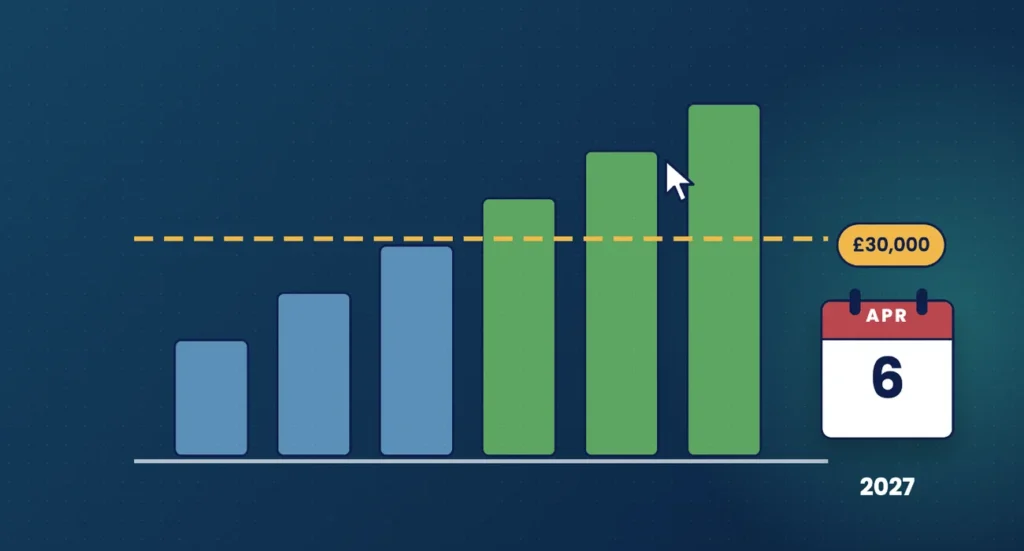
From 6 April 2027, sole traders and landlords with qualifying income over £30,000 must use Making Tax Digital for Income Tax. HMRC decides who is in scope from the 2025 to 2026 Self Assessment return, so the clients affected can be identified now from records you already hold. A further step to £20,000 follows from April 2028, based on the 2026 to 2027 return.
The MTD for Income Tax timetable
The rollout is phased by income, with each year’s group decided by the tax return two years earlier. The dates below are confirmed in HMRC’s eligibility guidance and in the Income Tax (Digital Obligations) Regulations 2026.
| Qualifying income over | Based on the return for | Must use MTD from |
|---|---|---|
| £50,000 | 2024 to 2025 | 6 April 2026 |
| £30,000 | 2025 to 2026 | 6 April 2027 |
| £20,000 | 2026 to 2027 | 6 April 2028 |
The government’s policy paper on the £20,000 threshold, published in March 2026, estimates that the April 2028 step will bring in around 970,000 more people.
How qualifying income is worked out
Qualifying income is the total of a person’s gross self-employment and property income, before expenses. It is turnover, not profit, which is where many clients get caught out. HMRC’s guidance on working out qualifying income sets out the detail.
What counts
- sole trader turnover, across all trades
- UK and foreign property income for UK residents
- the client’s share of income from jointly owned property
What does not count
- employment income taxed through PAYE
- a share of partnership profits as an individual partner
- dividends, including from the client’s own company
- State Pension and private pensions
Some examples show why this matters. A sole trader with £34,000 turnover and £12,000 profit is in scope. A landlord who owns a property jointly with a spouse and receives half of £64,000 rent has qualifying income of £32,000 and is in scope. An employee earning £60,000 with £8,000 of rent is not.
How HMRC will tell clients
HMRC says it will review the 2025 to 2026 return and write to people to confirm that they need to start using MTD for Income Tax from the start of the following tax year. For many clients, that letter will be the first time they take the change seriously, so it helps if you have spoken to them first.
The 2025 to 2026 return is due by 31 January 2027, only a little over two months before the April 2027 start. Waiting for HMRC’s letter leaves very little time to sort out software and records. Early filing gives everyone more room.
For the April 2026 group, HMRC has said that from September 2026 it will start signing up people who should be using MTD but have not signed up themselves, using the information it already holds. HMRC’s own guidance encourages signing up in advance so the details are correct from the start. Agents can sign clients up through their agent services account.
Exemptions
Some people are exempt, and others can apply for an exemption, for example if they are digitally excluded. Anyone due to start from 6 April 2027 can already apply. Flag clients who might qualify early, as HMRC needs to consider each application.
A plan for identifying and preparing affected clients
Step 1: run the numbers now
Filter your client list for sole traders and landlords. Using their 2024 to 2025 figures as a guide, flag anyone with combined gross self-employment and property income over about £25,000. That margin catches clients whose income is growing. Confirm against the 2025 to 2026 figures as each return is prepared.
Step 2: prioritise 2025 to 2026 returns for this group
Book these returns in early. Once the figures are final you will know for certain who is in, and the client hears it from you rather than in a letter.
Step 3: talk to each client
Explain what changes: digital records, four quarterly updates a year and a tax return at the end. Agree who will keep the records and who will send the updates. Many clients will find the move from annual paperwork to quarterly records the biggest change.
Step 4: choose software and get records digital
Agree the bookkeeping or bridging software each client will use, set up bank feeds, and ideally start keeping digital records before April 2027 so the first quarter is not also the first attempt.
Step 5: agree scope and fees in writing
Quarterly work is a different service. Update the engagement letter to set out who does what, the deadlines you need records by and the fee.
Step 6: sign up and authorise
Check that you are authorised for each client in your agent services account and sign them up ahead of the start date.
Readiness checklist
- Client identified as likely in scope from April 2027
- 2025 to 2026 return booked in early
- Client told what MTD means for them
- Exemption considered where relevant
- Software chosen and bank feeds connected
- Engagement letter and fee updated and signed
- Agent authorisation confirmed and client signed up
Frequently asked questions
Is the £30,000 threshold based on profit or turnover?
Turnover. Qualifying income is gross self-employment and property income before expenses.
Which tax return decides whether a client starts in April 2027?
The 2025 to 2026 Self Assessment return. If qualifying income on that return is over £30,000, the client must use MTD for Income Tax from 6 April 2027.
Is the £20,000 threshold confirmed?
Yes. The government has legislated for the £20,000 threshold from 6 April 2028, based on income in the 2026 to 2027 tax year.
Does income from a partnership count?
No. A share of partnership profit as an individual partner is not included in qualifying income.
How Engager helps
Engager’s custom fields and client filters let you tag clients by likely MTD start date and build a list for each group. You can then send targeted updates using bulk email and automated reminders, and set recurring quarterly jobs ready for April 2027.
Updated letters of engagement and proposals can go out for e-signature, and the TaxCalc integration keeps client data in step between your practice management and tax software.
Not using Engager yet? Start a free 28-day trial, with no card details required, or book a demo.