
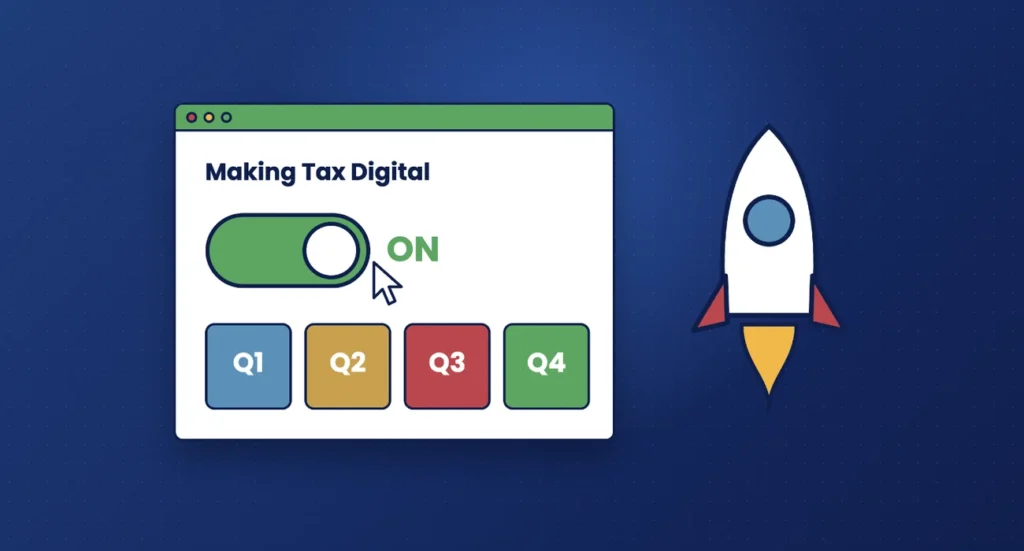
Making Tax Digital for Income Tax became mandatory on 6 April 2026 for sole traders and landlords whose qualifying income was over £50,000 in the 2024/25 tax year. They now need to keep digital records in compatible software and send HMRC a quarterly update, with the first one for 2026/27 due by 7 August 2026. The tax return still has to be filed after the year ends, and HMRC will not charge penalties for late quarterly updates in this first mandatory year.
If you look after self-employed or landlord clients, this is the first year the rules apply for real. Here is a practical summary of what changed, who is affected, and what your practice should be doing in the weeks before the first deadline.
Who has to use MTD for Income Tax from 6 April 2026
According to HMRC’s eligibility guidance, a client must use MTD for Income Tax if they are registered for Self Assessment, receive income from self-employment or property, and their qualifying income is over the threshold for the year.
Qualifying income is the total of their self-employment and property income before expenses (turnover), taken from the tax return for the earlier year. For jointly owned property, only the client’s share counts. HMRC’s guide on working out qualifying income includes worked examples.
| Start date | Qualifying income over | Based on the tax return for |
|---|---|---|
| 6 April 2026 | £50,000 | 2024/25 |
| 6 April 2027 | £30,000 | 2025/26 |
| 6 April 2028 | £20,000 | 2026/27 |
Partnerships do not currently need to use MTD for Income Tax. Employment income, dividends and other non-qualifying income do not count towards the threshold, although the client still reports them on their tax return.
What clients now have to do
For clients in scope, the year now has three parts.
Keep digital records
Each income and expense record must show the amount, the date and the category, using the same categories as the Self Assessment return. HMRC’s record-keeping guidance says records must be created before the quarterly update deadline for that period (or before the update is sent, if sooner). Spreadsheets are allowed, as long as they are digitally linked to bridging software. Retailers can record daily gross takings instead of individual sales.
Send quarterly updates
A quarterly update is a summary of totals for each income and expense category. HMRC does not receive individual receipts or invoices. Each update is cumulative, covering the tax year to date, so a mistake in quarter one can be corrected in the next update without resubmitting.
| Standard period (2026/27) | Calendar period option | Deadline |
|---|---|---|
| 6 April to 5 July 2026 | 1 April to 30 June 2026 | 7 August 2026 |
| 6 April to 5 October 2026 | 1 April to 30 September 2026 | 7 November 2026 |
| 6 April 2026 to 5 January 2027 | 1 April to 31 December 2026 | 7 February 2027 |
| 6 April 2026 to 5 April 2027 | 1 April 2026 to 31 March 2027 | 7 May 2027 |
The deadlines are the same whichever period type is used. Full details are on HMRC’s quarterly updates page.
File the tax return
After the year ends, the client (or you as their agent) submits the tax return through compatible software, adding any other income, allowances and reliefs. All quarterly updates must be sent before the return can be filed. For 2026/27 the normal Self Assessment filing and payment deadline of 31 January 2028 applies.
Penalties under MTD for Income Tax
MTD for Income Tax uses a points-based regime for late submissions, set out in HMRC’s penalties guidance:
- One penalty point for each missed quarterly update or tax return deadline (only one point per deadline, even with several businesses).
- For quarterly submitters, a £200 penalty once the client reaches 4 points, and a further £200 for each later missed deadline.
- Points below the threshold expire after 24 months. At the threshold, the client needs 12 months of on-time submissions and no outstanding returns from the previous 24 months to reset.
The important easement: there are no penalties for missing a quarterly update deadline for the 2026/27 tax year. Quarterly updates are still required, and they must be sent before the tax return can be filed. The easement does not apply to the tax return itself.
Late payment penalties also apply. For 2026/27, there is no penalty if tax is paid within 15 days, 3% of the tax owed at day 15 and a further 3% at day 30, then an annual rate of 10% charged daily. HMRC has published higher rates of 4% at day 15 and day 30 from 2027/28.
Exemptions
Some people are exempt automatically and do not need to apply, for example those without a National Insurance number before the tax year starts, trustees and personal representatives. Others can apply to HMRC if they are digitally excluded, meaning that age, health, disability, religious beliefs or lack of internet access make it impractical for them to use software. HMRC’s exemptions guidance lists the categories. Agents can apply on a client’s behalf.
A checklist for the next few weeks
- Confirm which clients had qualifying income over £50,000 in 2024/25, including joint property shares.
- Check each in-scope client is signed up and that you are authorised as their agent for MTD for Income Tax.
- Agree whether you or the client will keep the digital records, and in which software.
- Decide on standard or calendar update periods.
- Set an internal deadline well before 7 August 2026 for records to reach you.
- Review any clients who may qualify for an exemption.
- Update engagement letters and fees to cover quarterly work.
- Start identifying clients likely to be over £30,000 for April 2027.
Frequently asked questions
When is the first MTD for Income Tax quarterly update due?
For the 2026/27 tax year, the first quarterly update is due by 7 August 2026, covering 6 April to 5 July 2026 (or 1 April to 30 June 2026 for calendar periods).
Is there still a tax return under MTD for Income Tax?
Yes. Quarterly updates do not replace the tax return. The return for 2026/27 is filed through compatible software after the year ends, with the usual 31 January 2028 deadline.
Will my client be penalised for a late first update?
Not for 2026/27. HMRC has said there are no penalties for missing quarterly update deadlines in this tax year, but the updates must still be sent before the return can be filed.
Do partnerships need to use MTD for Income Tax?
Not at present. HMRC’s guidance says partnerships do not currently need to use it.
How Engager helps
Engager does not file quarterly updates (that is the job of your MTD software, such as TaxCalc). What it does is help you run the work around them: you can set statutory and internal deadlines, organise jobs with task management and Kanban boards, and send clients automated reminders to get their records in on time.
You can also issue updated letters of engagement with built-in e-signatures, so the new quarterly service is properly documented before the first deadline.
Not using Engager yet? Start a free 28-day trial, with no card details required, or book a demo.