
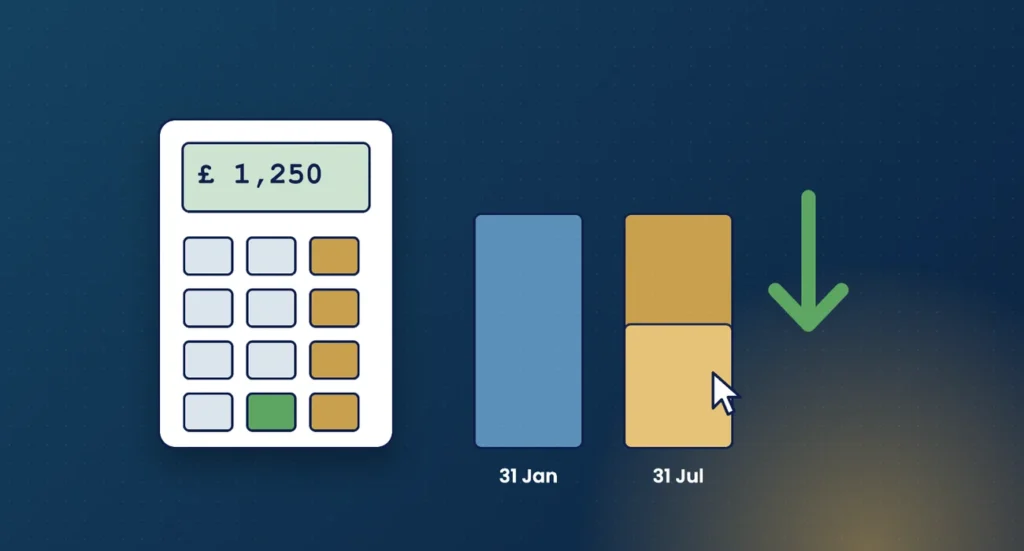
The second payment on account for the 2025 to 2026 tax year is due by 31 July 2026. If a client’s income has fallen, their reliefs have gone up or more tax is being deducted at source, you can apply to reduce it online or using form SA303, as long as the claim is based on a reasonable estimate. Reduce too far and the client will pay interest on the shortfall, so the aim is an accurate figure, not the lowest one.
How payments on account work
Payments on account are advance payments towards a client’s Self Assessment bill. GOV.UK’s guidance on payments on account explains that each payment is half of the previous year’s bill, and they are due by 31 January and 31 July.
For the 2025 to 2026 tax year, that means:
- First payment on account: due 31 January 2026.
- Second payment on account: due 31 July 2026.
- Balancing payment, if more is owed: due 31 January 2027, alongside the first payment on account for 2026 to 2027.
If the final bill is higher than the payments on account, the client pays the difference as a balancing payment by 31 January following the end of the tax year.
Who has to make them: the £1,000 and 80% rules
A client does not need to make payments on account if either of these applies to their previous year’s position:
- Their last Self Assessment bill was less than £1,000.
- They had already paid more than 80% of all the tax they owed, for example through their tax code or because tax was deducted from interest.
HMRC’s Self Assessment legal framework manual confirms that payments on account are based on income tax (and Class 4 National Insurance) after tax deducted at source. Capital gains tax and student loan repayments are not included; they are paid with the balancing payment.
When reducing payments on account makes sense
The claim to reduce payments on account guidance lists three situations where a client can apply:
- Their business profits or other income have gone down.
- They are entitled to more tax relief.
- More tax is being deducted at source than in the previous year.
Common examples include a sole trader whose trade has slowed, a landlord who has sold a property, a client who has moved from self-employment into employment, or someone whose one-off income in the previous year will not recur.
How to reduce payments on account
There are two routes:
- Online, through the client’s Self Assessment online account, using the “Reduce payments on account” option.
- By post, using form SA303, which you fill in on screen, print and send to HMRC.
The claim needs an estimate of the client’s income for the year, so HMRC can recalculate the payments. The deadline for a claim is 31 January after the end of the tax year, so for 2025 to 2026 it is 31 January 2027. In practice, the best time to look at it is before 31 July, so that the second payment reflects a realistic figure.
The risks of reducing too far
A reduction is only a good idea if it reflects the likely liability. GOV.UK is clear that if the reduced payments turn out to be too low, the client will be charged interest on the difference. HMRC’s late payment interest rate is set at Bank of England base rate plus 4 percentage points, as shown on its interest rates page, so it is not a cheap way to borrow.
There is also a penalty for claims made fraudulently or negligently. HMRC’s guidance says it does not apply to innocent errors, or where the taxpayer acted in good faith on information that later changed. It is aimed at large reductions with no foundation and repeated claims that leave the client paying too little year after year.
For that reason, keep a note on file of how you arrived at the estimate and what the client told you.
A planning checklist for July
| Step | What to check |
|---|---|
| 1. Identify | Which clients have a second payment on account due on 31 July 2026. |
| 2. Compare | The current year’s likely income against the previous year’s. |
| 3. Estimate | A realistic liability, using management accounts, bookkeeping records or MTD quarterly figures where available. |
| 4. Decide | Whether a reduction is justified, and by how much. Leave a margin if the figures are uncertain. |
| 5. Apply | Online or using SA303, before the payment date where possible. |
| 6. Record | Keep the workings and the client’s confirmation on file. |
| 7. Communicate | Tell the client the revised amount, the due date and what to expect on 31 January. |
Help clients plan for January too
July is a good moment to talk about the January bill. A client who reduces their payments on account now still faces a balancing payment and a new first payment on account in January 2027. For clients who joined Making Tax Digital for Income Tax from April 2026, the estimate HMRC provides after each quarterly update can be a useful starting point for the 2026 to 2027 conversation, though it is only an estimate.
Frequently asked questions
When is the second payment on account for 2025 to 2026 due?
By 31 July 2026. It is normally half of the client’s 2024 to 2025 Self Assessment bill.
Can I reduce payments on account to zero?
Yes, if a reasonable estimate shows the client will not owe tax that requires them. If the estimate proves too low, interest is charged on the difference.
Who does not need to make payments on account?
Clients whose last Self Assessment bill was under £1,000, or who paid more than 80% of their tax through deduction at source, such as through a tax code.
What is the deadline for an SA303 claim?
31 January after the end of the tax year. For 2025 to 2026, that is 31 January 2027.
How Engager helps
Engager’s automated emails and reminders and bulk email and SMS make it straightforward to remind clients about the 31 July payment and to ask for up-to-date figures before you review a reduction. Statutory and internal deadlines on jobs keep the review on your team’s radar.
Custom fields can record which clients have had a reduction and why, and the TaxCalc integration keeps client data in step with the software you use to prepare and file returns.
Not using Engager yet? Start a free 28-day trial, with no card details required, or book a demo.