








Grace Hardy set up Hardy Accounting two and a half years ago. The firm now has four people and works mainly with creative businesses, product companies and tech startups.
For most of that time, the practice ran on a spreadsheet and on Grace’s memory. That was fine while she was the only person who needed to know what was due.
The challenge
Growth changed that. Once freelancers and then employees joined, the work had to be visible to more than one person.
“It was because the firm became bigger than me. When it was just myself, everything was in a spreadsheet because it was cheap and easy and everything lived in my head. It didn’t really matter because no one else needed to know about it.”
Bookkeeping, tax returns and annual accounts were all tracked as notes in the same sheet, and it could not keep pace with the firm.
“I was just noting down everything in the spreadsheet: think this bookkeeping needs done, think this tax return needs done, these annual accounts are due soon. As you can imagine, it was very chaotic.”
Moving to practice management software for the first time felt like a risk. Speaking to firms that had already switched, and getting help with the set-up, made the move far easier than Grace expected.
The solution
One view of every job
Engager gave the team a shared view of deadlines and jobs. When one person finishes their part of a job, the next person can see it is ready for them.
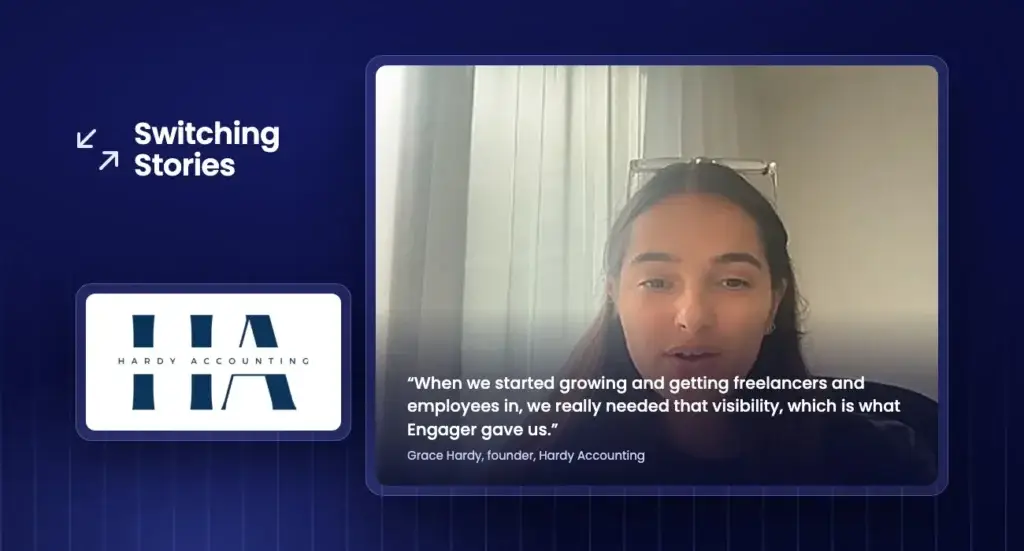
“When we started growing and getting freelancers and employees in, we really needed that visibility, which is what Engager gave us.”
Client emails built into the workflow
Emails to clients now go out from the job itself, so anyone on the team can send them without needing access to Grace’s inbox. Every message is kept against the client, which has already settled questions about whether something was sent.
“If we start a job and the first task is pressed complete, it brings up an email requesting the bank statements, and it sends directly to the client. We just edit the date that we need it for. All the approvals and reviews get sent on Engager as well.”
Onboarding in one flow
Onboarding used to be done by hand. Grace built an onboarding flow in Engager that sends the emails, stores tax references and handles authorisation, with anti-money laundering checks and Adfin set up alongside, rather than across separate websites and apps.
“We created an onboarding flow in Engager, so it has all of the emails, and we can keep everyone’s tax references in and do the authorisation through there as well. It just saves so much toing and froing from different websites and apps.”
Connected to the rest of the stack
Hardy Accounting uses TaxCalc for accounts and tax, connected to Engager, along with the HMRC, Adfin, Xama and Companies House integrations. Small jobs, such as adding a company’s directors, no longer need typing in.
“It’s just having that seamless process so that everything is almost like speaking with each other. The integrations that come with Engager are brilliant.”
The result
The clearest sign of change for Grace is what happens when she is away. On a recent holiday, the team kept work moving in Engager, and she came back knowing exactly where everything stood.
“Everything is there, it’s so perfect. It helps so much with processes and workflows, especially as we expand. Different freelancers, different employees can come into the firm and pick up things and know where things are. Whilst I was on holiday, people were clicking through Engager jobs, so when I came back, I knew exactly where everything was.”
The bottom line
Hardy Accounting has moved from a spreadsheet only its founder could read to a system the whole team works from, with:
- Shared visibility of every job and deadline
- Client emails sent from the workflow, with a full record
- One onboarding flow instead of several websites and apps
- A practice that keeps running when the founder is away