

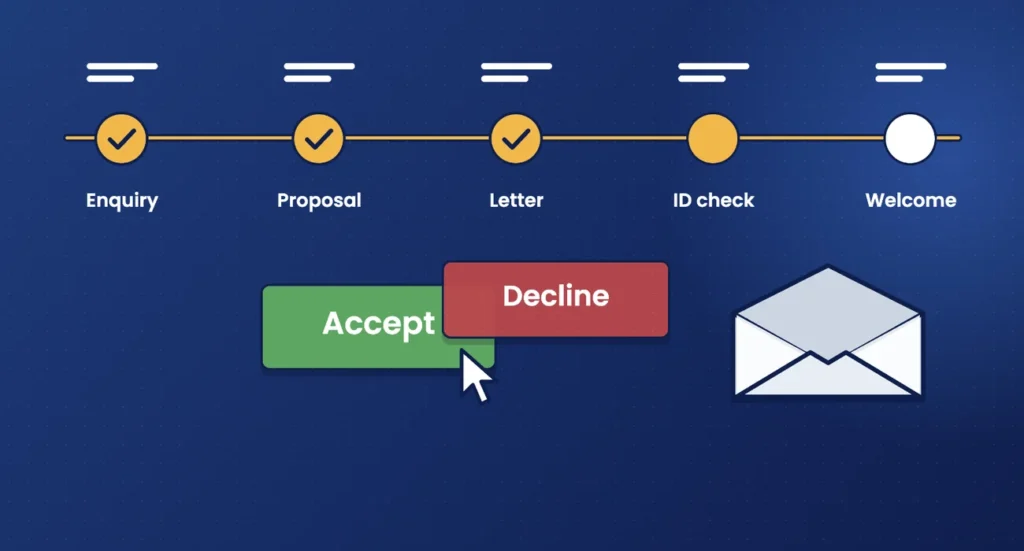
A good client onboarding process for a small accounting practice follows the same eight steps every time: handle the enquiry, send a proposal, issue an engagement letter, complete AML and identity checks, request professional clearance, get HMRC agent authorisation, collect records and set up the first job. Doing them in a fixed order means nothing is missed, the client knows what to expect, and you have the evidence your AML supervisor will ask for.
Below is a practical walk-through of each stage, with the legal requirements you need to meet along the way.
The onboarding process at a glance
| Step | What happens | Done when |
|---|---|---|
| 1. Enquiry | Capture contact details and what the client needs | Initial call or meeting held |
| 2. Proposal | Agree services and fees | Client accepts proposal |
| 3. Engagement letter | Set out scope, responsibilities and terms | Letter signed |
| 4. AML and ID checks | Customer due diligence and risk assessment | Identity verified and risk recorded |
| 5. Professional clearance | Contact the previous accountant | Reply received and reviewed |
| 6. HMRC authorisation | Become the client’s agent for each tax | Authorisations confirmed |
| 7. Collect records | Gather documents and system access | Records complete |
| 8. First job set-up | Create jobs, deadlines and reminders | Work scheduled |
Step 1: the enquiry
Record the basics at first contact: name, entity type, services needed, current accountant and any urgent deadlines. A short call is the best time to spot red flags, such as a client who is vague about their business or reluctant to say why they are changing accountant. Note anything that will affect the AML risk assessment later.
Step 2: the proposal
Set out the services and fees in writing. A clear proposal avoids scope creep and lets the client compare options. Include any one-off work, such as catching up late returns, as a separate item.
Step 3: the engagement letter
The engagement letter defines what you will and will not do, the client’s responsibilities, fees, and the terms of the relationship. Your professional body will have guidance and template wording. Get it signed before you start chargeable work.
Step 4: AML and identity checks
Accountants and bookkeepers are covered by the Money Laundering Regulations 2017 (MLR 2017). When you establish a business relationship, you must apply customer due diligence (CDD).
What CDD involves
Under regulation 28, you must:
- identify the client and verify their identity, on the basis of documents or information obtained from a reliable source independent of the client;
- where the client is beneficially owned by someone else, take reasonable measures to identify and verify the beneficial owners, and for companies and other legal entities, understand the ownership and control structure;
- assess, and where appropriate obtain information on, the purpose and intended nature of the business relationship.
The extent of your checks must reflect your firm-wide risk assessment and the risk presented by the client, so it can differ from case to case. Higher-risk situations require enhanced due diligence.
When to do it
Regulation 30 says verification must take place before the business relationship is established. There is a narrow exception where it is necessary not to interrupt the normal conduct of business and the risk is low, in which case verification must be completed as soon as practicable. CDD also continues after onboarding through ongoing monitoring.
Keep the evidence
Regulation 40 requires you to keep copies of the documents and information used for CDD for five years from the end of the business relationship.
If HMRC is your AML supervisor, its accountancy sector guidance for money laundering supervision covers CDD, record keeping and suspicious activity reporting, and was updated in January 2026 with guidance on risks common to accountancy service providers. If you are supervised by a professional body, follow its guidance too.
Step 5: professional clearance
If the client has an existing accountant, contact them before you accept the appointment. The ICAEW’s guidance on changes in professional appointment explains that you need the client’s consent (preferably in writing) to make the enquiry, because of the duty of confidentiality. Ask whether there is any professional reason you should not accept, and request handover information such as prior returns and outstanding deadlines. Other professional bodies have equivalent requirements.
Step 6: HMRC agent authorisation
You need to be authorised for each tax you will deal with. How you do that depends on the tax, as HMRC’s guide to authorising an agent explains:
- Self Assessment, Corporation Tax and PAYE: online agent authorisation (HMRC posts a code to the client to pass to you) or the paper 64-8 form.
- MTD for Income Tax and VAT: the digital handshake, where you send the client an authorisation link from your agent services account. The 64-8 cannot be used for these.
Start this early. Authorisation can take time, and you cannot discuss the client’s affairs with HMRC until it is in place.
Step 7: collect records
Send the client one clear list of what you need, with a date. Typical items include:
- prior year accounts and tax returns (often from the previous accountant);
- bank statements and access to bookkeeping software;
- Unique Taxpayer References, VAT and PAYE references;
- Companies House authentication code, for companies;
- details of income sources, for sole traders and landlords.
Step 8: set up the first job
Create the client’s jobs, statutory and internal deadlines, and reminders before the first piece of work starts. Assign responsibility so the client is not left between team members.
Onboarding checklist
- Enquiry details and red flags noted.
- Proposal accepted.
- Engagement letter signed.
- Identity verified, beneficial owners checked, risk assessment recorded.
- CDD records filed for retention.
- Professional clearance received.
- HMRC authorisations confirmed for each tax.
- Records received.
- Jobs, deadlines and reminders set up.
Frequently asked questions
Do I have to verify a client’s identity before starting work?
Generally, yes. MLR 2017 regulation 30 requires verification before the business relationship is established, with only a narrow low-risk exception.
How long must I keep AML records?
Five years from the end of the business relationship, under regulation 40.
Is professional clearance a legal requirement?
It is a professional requirement set by bodies such as the ICAEW rather than a statutory one, but it is expected practice and protects your firm.
Can I use form 64-8 for every tax?
No. MTD for Income Tax and VAT use the digital handshake through your agent services account.
How Engager helps
Engager covers most of this process in one place: proposals, letters of engagement with built-in e-signatures, professional clearance letters, and client onboarding forms. AML checks are available through integrations with Xama and Armalytix.
You can request HMRC agent authorisation from the client record using the HMRC 64-8 integration, pull company details from Companies House, and set up jobs, checklists and automated reminders once the client is on board.
Not using Engager yet? Start a free 28-day trial, with no card details required, or book a demo.